I have spent the last 22 years of my life learning about what is right and what is wrong for every possible topic I have ever been subjected to. Like how there is a right and wrong way to make a cake, there is also a right and wrong way to drive a car, and there is also a right and wrong way to record music.
This all made a lot of sense to me growing up because it put everything into neat little piles divided by a very thick and noticeable line.
But sometime in high school, I realized that everyone had there own sense of what is right or wrong and, after some intense arguments that left both my opponent and myself exhausted and no further convinced of each others’ views, I concluded that there is no right or wrong, just different preferences.
But now here I am, out of college, out of work, and barely in a band like I once was, I see again that there is a such thing as a definitive right and wrong, the only thing different from before is that there are finer details that can determine if something is right or wrong and not just the whole overall topic.
I will describe this the best way I know how, by using a guitar…
Imagine this is a standard tuned guitar, well, just the top of it and the lower part is facing you. Some may recognize this view from guitar tablature.

Alright, now I tell you to play an E, what do you do?
Did you play that low string open?
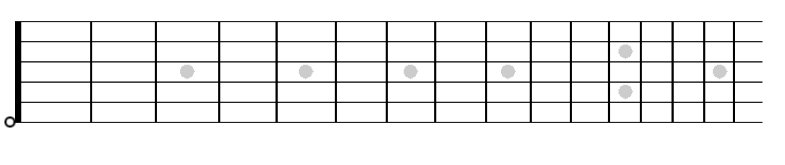
Then you are right! sort of…
Did you play the highest string open?
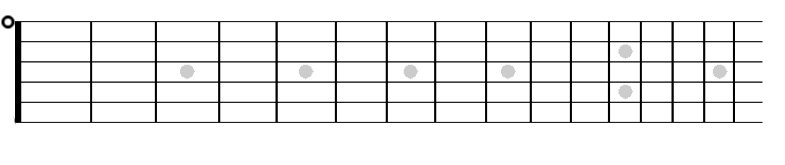
Then you are also right! … sort of, again…
What if you played a big ole E major chord?
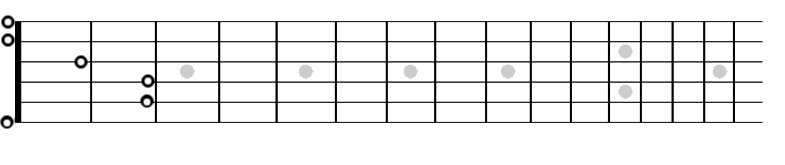
Same deal.
The problem here is that I did not specify what sort of E that I wanted. You could also have fretted an E anywhere you would’ve liked and still have been right.
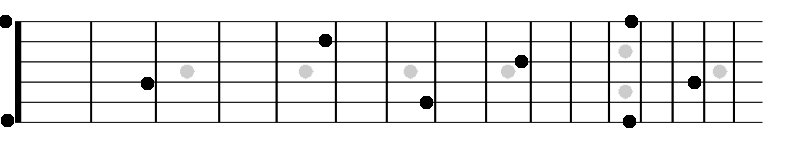
Now, if I was a mean and grumpy person, I could’ve gotten mad at you for not knowing what I meant (It was actually an Emin7 in 7th position, but you got a bit too fiesty youngin’!), or I could be a reasonable person and apologize that I wasn’t specific enough to get you going in the right direction.
What I see too frequently with this right or wrong mentality is that if I don’t do something the way that Some-Big-Recording-Snob-Wannabe learned, then it is wrong and therefore I and all of my sources are wrong. These people never escaped my old high school mentality and don’t have the openness to learn from peers.
In the recording world, you obviously want to avoid going so overboard that you lose all the sound of whatever it was you were recording or just flat out causing so bad of phase issues that all you hear is garbage. There are a bunch of convenient guidelines that can help push you in the right direction to keep you from ruining every possible track you get your hands on. The problem with these guidelines is that some people take it as gospel and then they dismiss new ideas and techniques because they hear it from someone who does not fit into their list of original mentors or idols.
What I am trying to say, is that I have crazy ideas from time to time, and I want to try them out. The problem with this is that the people around me see something they are not accustomed to and they immediately jump in to correct me. They jump in and feel compelled to inform me that my ways are wrong, and that I need to do it in this exact specific manner to be right at all. My response to them is – you are wrong for not understanding how to record, it is not how the mics look or where they are, what is truly important is how it sounds after all has been set. If it sounds horrible, then I know what to fall back on, but don’t discount new ideas because I’m some young guy that wants to try something out. Maybe I will end up failing, but I am right to give it a go before I settle.
Sure, maybe I prefer a Sennheiser 421 over a Shure 57 for bottom snare and I’m not a huge fan of kick drum tents. But that doesn’t make me wrong, it just means that the sound that I like and the sound that I choose to pursue differs from your own. I might just prefer to keep it simple on guitar miking, 2 close mics and maybe one room mic for some depth is all you would ever need, but others may want more. Hell, I get away with 2 mics a lot of the time.
All I can say is that I am not a millionaire studio owner, or even a decently paid intern, but I do have a love for music and doing my very best so that I may feel proud of the product I created. It is just hard to spend so much time focusing all of your energy on your own music and also at the same time trying to draw in business to record or produce others music and still experiment with different noises. So keep an open mind, read up and practice everything.
And always remember, make adjustments according to your ears, not your eyes…
 RJ Ellsworth